Friday, November 30, 2007

Joshua, a film by George Ratliff (2007)

He may be a sweet looking kid, but appearances are very deceptive when it comes to Joshua Cairn (Jacob Korgan). I guess most kids feel a bit left out when the second child comes along and they are no longer the centre of attention. Joshua just won't let it go: he is one of the most creepily horrible kids I've seen for a long time. Quite an achievement for someone who is only twelve (and playing a nine year old boy).
Since I only went along because Rialto sent me a free ticket, I had no idea what to expect. At first it was like any family drama, with touching moments of bonding when the kid asks his dad (Sam Rockwell) "Do you think I'm weird?" and dad being quick to assure Joshua of how normal he is. This scene echoes somewhat later in the movie, when dad says to Joshua "I think you're sick". Young Joshua doesn't think so, gives a sort of sniff and is sure he's not sick.

It is a battle for control of the household, and Joshua is the undoubted winner. He knows his mum's (Vera Farmiga) weak points (such as finding it unbearable when her daughter cries) and exploits them to the point she needs to be taken away to somewhere quiet. In today's climate where a mere whisper is enough to condemn a father of child abuse, Joshua is in his element.

Labels:

Sunday, October 28, 2007

Atonement - a movie

When I read Ian McEwan's book, I found myself fully caught up in Briony Tallis's need to atone - I thought it was wonderful, the way in which McEwan had set up the events for which Briony felt the need to atone and the slightly ambiguous way in which those events were depicted. I also thought it some of the finest war writing I'd read in quite a while, and bought the difficulties Briony faced in trying to reconcile with her sister Cecilia and Robbie. If that had been the story, I would have been satisfied; instead I felt cheated and confounded by the smart arse way in which McEwan chose to end the book. I hated it.

Curiously, I did not have this reaction when I saw the movie. Maybe it was because I knew it was coming. Maybe it was because the movie tended to take a cleaner line through the story than had been taken in the novel, things were just a little more obvious and thus less engaging: I had less invested in working things out.

I did, however, think it a marvellous movie. The Tallis's are old money, with an estate. Class is an issue for them, so it is something of an imposition that, thanks to some sort of financial difficulty, they're putting the country cousins up. Briony at this stage is just 13, played by one Saoirse Ronan. She has an active imagination: the movie starts with her attempts to put on a play she has written.

Keira Knightley is her older sister, Cecilia. Since I really detested Cecilia, thought her a terribly affected snob, I think Knightley did a very good job of playing her, although it does raise a question: how did such a person stoop so low as to find herself in love with the cook's son, Robbie (James McAvoy)? What did he see in her? Sure, when they were growing up together, they were best of mates, but he says that when they were at Cambridge (or was it Oxford) together (Robbie's tuition was paid for by Mr Tallis), she ignored him completely. Now, they can't ignore the passion.

It is these sorts of tensions which are at the heart of the movie. Briony, despite being so young, has developed an infatuation for Robbie: she tested his mettle by throwing herself in a pond, hoping he'd save her. He did, and thus there's an element of hero worship to her devotion. So when things start to happen between Robbie and her older sister, Briony can't sit idly by. She falsely accuses Robbie of a crime, and has some ambiguous evidence which sees him convicted. It was funny; as I watched this, I was reminded a little of Lolita, at least as Humbert Humbert imagined her - someone capable of both sexual desire and control. But no-one could ever believe that of Briony, she is so young and pure. Thus her accusations against Robbie must be true. Other viewers write of seeing her as an innocent, as getting into things she does not understand and this making mistakes and certainly that is one way to interpret her actions in the book. The movie, not so much; it casts her as planning some sort of revenge upon Robbie; although I do accept she may not have have really thought through all of the consequences of her actions, her motivation is made quite clear.

This is the event, shown in the early part of the movie, for which Briony must atone. As she gained consciousness of what she had done, this must have put enormous stress on Bryony - this is not shown in the movie, just an apparent attempt on her part to reconcile with her sister; the intervention of World War Two did not help as Robbie was released from prison to be sent off to the front line, Cecila to be a nurse. Curiously, a lot of time is devoted to their respective lives during the war even though it does very little to advance the plot and, well, more doubts are raised about the point of these scenes in the final twist at the end.

Labels:

Saturday, January 27, 2007

Home Again

Well, it is actually a week or so since I arrived home to a grey, cold and wet Dunedin. People have been quite impressed in the effect that my holiday has had on me - saying it has taken ten years off me, that there is a new spring in my step and that I've lost weight (although there were those who thought I might return stick-thin as a result of some dread illness or other). And, yes, I have returned feeling relaxed and ready to embrace another year.

Hanoi

In all, I spent a week in and around Hanoi - sleeping till noon most days, and then exploring in a modest way. Most of my time was in and around the backpacker district, Hoan Kiem (a.k.a The Old Quarter) - a maze of narrow streets occupied by a bewildering assortment of traders, with masses of motorbikes and pedestrians fighting for space. It came as no surprise to read in the Vietnam News that there are a lot of vehicle on pedestrian accidents: what was surprising was that I neither saw nor suffered an accident. It was only on my last full day, when I was looking for a Singaporean restaurant I read about, that I found a part of Hanoi that I think I would have been far more comfortable staying in. It had wide streets, lots of very nice looking restaurants (aimed at middle-class Vietnamese) and was a lot more peaceful.

Never mind: at least by staying where I did, I had a date, of sorts. Once thing I had noticed was that all the people who come up and started talking were men or kids, no women. This changed as I was wandering along the lakeside, on my way to the Vietnamese movie I mentioned in the last post. This woman came up alongside me, and just started talking, saying it was her 29th birthday. As I wandered, she wandered with me, all the way to the cinema. Since I had time to kill, and couldn't really just wander off to the internet cafe, we had a beer. Somehow, my asking if she liked watching movies was translated into an invitation to watch the movie with me. There was still more time to kill, so my companion decided she'd eat. It was very cool to see her enjoy the movie as much as I did, although I think the Q & A with the director afterwards pretty much sent her off to sleep. As we returned to my hotel after the movie, I was beginning to get anxious, as to what might be in her mind, but luckily she just shook my hand and wandered off.

The other cool thing I did in Hanoi was to go watch the water puppets - a traditional form of theatre that has been a part of Vietnamese culture since around the 11th century. All sorts of scenes were played out, with fishermen catching fish, farmers tending their crops or herds, dragons (fireworks substituted for dragon breath) - I was having real trouble working out any sort of story line. When I looked at the programme afterwards, I saw why - the idea was basically to give a survey of life in Vietnam.

My last meal in Hanoi was in a French restaurant, a slightly posh place in an old colonial building opposite my hotel. I had actually made plans with myself to eat at the Sofitel Metropole, which was reputed to have the finest French restaurant in the country, but I felt weird about spending $30 on a main course for just me, which I think was itself a bit strange.

Since I had a lot of time to kill between having to check out of my hotel and check in time at the airport, I decided not to bother with taxis and just take a public bus. Despite being something like four hours early for check in, I still managed to be one of the last to board my plane, thanks to the shambolic way that Tiger Air check in was operating.

Singapore

I had around 48 hours in Singapore on the way back, which was useful: it confirmed my initial impression that Singapore is a great place. In fact, while I was there, I did a bit of checking up on the National University of Singapore, to see if it might prove to be a suitable place to spend some sabbatical time.

This time round, I was staying in the Geylang area - reputed to be the redlight district, but it was pretty tame. I think I was only propositioned twice. The good thing about this part of town is that there are a lot of restaurants which stay open around the clock - although their food prices were a bit of a shock after the rest of SE Asia (and, indeed, the foodcourts). Since I was on the home stretch, I decided I'd do some serious shopping, not that I wanted anything in particular, so I spent my time in the various malls on Orchard Road. I have to make special mention of Carrefour: I had bought quite a few books and some clothes and it was getting to be a bit of a mare lugging it all around, so I bought a bag to make things easier. It had been knocked down to a mere $7, but when I got to the checkout, it rung up at a higher price. Here, they might well just hope you didn't notice and charge that, but in Carrefour they obviously take such errors seriously. They went beyond charging me the right price, by giving me a $5 gift voucher to apologise. Now that is good customer service.

Unlike what Tiger Air provided. They're a non-allocated seat airline, so as soon as the gate was announced, there was a free-for-all to be first in line. What Tiger didn't say was their schedule meant that the plane we would fly on wouldn't actually arrive until after we were supposed to depart. And so, we all rushed to get in line, and then we stood there in line for more than an hour. Ah well, that's the cost of flying on a budget airline.

Darwin

When I was in Darwin in November, it was still the dry season, so Darwin was a bit dusty and drab looking. By the time I returned, however, the wet season was in full swing, and the place was looking fantastic. It is a city with a LOT of trees - flying in and then driving around in various buses, it was at times hard to detect the buildings, as the trees had taken over. I'd say it is not just the rain but also the heat which contributes to this, making it like a greenhouse.

Thanks to this heat and the plane being late, I found that the hostel room I had booked was pretty much unnecessary - there was no way I could sleep. So, instead, I lined up at the cafe in the bus station as soon as it opened at 5:30 and had an enormous breakfast of scrambled eggs and bacon, while I chattered away to a fellow I met there, a retired Chemistry Professor from Wisconson - he and I crossed paths several times during the day.

I actually had a mission to undertake while in Darwin - I wanted to check out portable DVD players, and so had to take a bus trip to Harveys, several miles south of town. Sitting on the bus stop to come back, I got talking to a local fellow; of course, the weather came up for discussion. He thought it was a particularly long time since it had rained - all of four days! He was right, however, in saying it was due to rain again. I was waiting for another bus when it started - luckily I was under a verandah, but the rain came down so heavily that even traversing the small space between the edge of the verandah and the bus was enough to see me soaked. It made it a fantastic trip up to the shopping mall - there was already so much water puddled that it was splashing right over the top of the bus.

I spent my last hours in Darwin first in going to the Northern Territory library and hanging out there for a couple of hours, then having a good pub meal with a couple of beers and then watching The Holiday. Cool movie - I'd seen lots of shorts for it, so had picked up the story line about the Cameron Diaz character trying to escape men for a while by going to Cate Winslett's little village in Devon, but finding a fellow there anyway (who has two unbelievably cute daughters). But there was a whole other storyline involving Cate Winslett in LA: she befriends her neighbour, who is a prominent screenwriter: he hooks her up with a host of movies from the golden age of cinema. I think that those who made this movie are taking a shot at recreating that age. Winslett also meets Jack Black: they're both in really crappy relationships with people who're just using them (this was laid on a bit thick) but, of course, by movie's end the scales have dropped.

Brisbane

I managed a couple of days in Brisbane while I waited for my flight back to Dunedin: my fourth visit, and I think that every time I've been, I've liked it more. Sydney and Melbourne vie with each other to be the best city, but in some ways Brisbane has the best of each. Having the river run through it makes it very special, and then using that river as a central feature of its public transport network is inspired.

My first day was a bit of a write off - I arrived at 7 in the morning, my second night of no sleep, but couldn't check in to the hostel until after lunch. To fill in time, I randomly picked a destination on the train line and found myself in Shorncliff - a very tidy beachside suburb, where the houses were predominantly older but immaculately maintained.
The only commercial activity I spotted was a takeaway bar, and an Italian cafe. Apparently, way back in the day, they used to run train excursions here from Ipswich.

Once in the hostel, I slept until 8, then went for a wander around the New Farm/Newstead area, the sort of place I'd live if I was a Brisbanite - lots of apartments (including some magnificent conversions of the old woolstores), bars, cafes and at least one coffee roaster (Caffeine - I came her for breakfast the next day, and it was good). Around the river, in the West End, I found a heap more cafes, two decent bookstores, an alternative movie rental place and, most interesting, a shop that had more than 120 different beers in stock.

And so, the very last night of my holiday was spent in Brisbane: a friend has recently moved here from Dunedin; he and I had a very pleasant dinner at the Himalayan cafe, he dropped me off at the far end of the CityCat run so I could have a final blat up the river.

Labels: , , ,

Sunday, January 14, 2007

Hanoi Cinematheque

I was starting to get withdrawal symptoms - the last movie I had seen in a real movie theatre was Borat way back in Darwin. While there are cinemas in most towns of any size here (although their numbers have been knocked back dramatically by easy access to DVDs (Da Nang has gone from something like 9 cinemas to 2)), they naturally play movies without any English sub-titles, or dub English films into the local language. I did think that seeing one might be an interesting cultural experience, as apparently they're dubbed really badly (there are rumours of a single person simply reading from a prepared script for all voices), but the movies on show aren't ones I'd want to see even in English.

Of course, travelling by myself through places with limited nightlife and having little interest in extended periods in bars, I have seen quite a few movies on TV (even the cheapest of hotels has cable TV here). In among the various family and criminal dramas, I have seen two films which really impressed me, both French as it happens. I have also found that I have retained enough French to actually follow French subtitles, although they tend to speak too fast for me to keep up with speech (don't ask why a French movie has French sub-titles!). This, and listening in to conversations in cafes in Vietnam and eating French food has aroused a great desire to see France again, and soon.

Anyway, the two movies are Gigi and Capone. Gigi is a recently made movie of Colette's novel of the same name: she seems to be a French Jane Austen. Gigi's grandmother and aunt see her as the answer to the family's poor fortunes and have big plans to marry her off (thinking that if she can first have a disastrous affair with a young fop who claims to have fallen madly in love with her, that will soften her up). Her mum doesn't have much to say about any of this, but Gigi herself is totally opposed: she wants to marry for love. It just so happens that she has fallen for a childhood friend, who is much wealthier than any man the aunt might secure - so much so that the family think he is way beyond Gigi. There is a great scene towards the end, when he makes an offer to Gigi - basically to be a kept woman, without any mention of the feelings we know he has for her or, of course, of marriage. Her answer "on those terms, I must refuse you". That's not quite the end of the story.

The other, Capone is a mad road movie. I missed the very beginning, but my understanding is that Reno is a bit of a crook, and has some significant debts because he's not a very good crook. He sees this horse, Capone, and thinks it will be the answer to his problems if he races him - ripping off its owners in the process. Now his immediate problem is that he has a horse in a horsefloat in France, but has no vehicle and no money: the race (the "midnight sun" race) is in Lapland, to the north of Finland. So - he calls a cab! Alex is his driver - he takes some persuading (the promise of a large sum of money), but he does it. They're quite different people - Alex is responsible, clean and organised (Reno is not), so theirs is a relationship which takes a while to kindle. Of course, to add interest, the owners of the horse are on their trail, and they keep encountering a gypsey horse owner, who wants to buy Capone. But the fantastic thing about the movie for me was the journey itself.

Anyway, as I was travelling, I started to hear of the possibility of a cinema in Hanoi, which not only showed English films, but the more pretentious arthouse movies that I like to watch. My informant was very vague on details but, wandering around Hanoi, with an address gleaned from the net, I stumbled upon it, the Hanoi Cinematheque - it is part of an arts precinct funded by the Vietnamese Government, which includes a hotel (des artistes), several art galleries, a bar all set around a wonderful little courtyard where you can get away from the noise of Hanoi.

Sure enough, they had an interesting programe of films, which changed every day. You pay a $10 membership, and can then watch as many movies as you want (although a koha is appreciated). I was only able to watch three movies - the first two were classics of the black and white era. Big Heat was directed by Fritz Lang (of Metropolis fame) : Sergeant Bannion is suspicious as to why one of his colleagues committed suicide and starts to investigate: pressures on him to stop start immediately. Of course, the entire police department and the political structure turn out to be corrupt, so the forces against him are immense, but he struggles on. Lee Marvin performed his first role here, as crime gang tough guy Vince Stone: it is only when he throws coffee into his girlfriend's face that Bannion finally gets the critical support he needs to unravel the whole corrupt structure (as we know he must). The other, Night of the Hunter, I had seen before, but it was great to see it again. Robert Mitchum was such a creepy presence in this movie - playing the sanctimonious "preacher" Harry Powell (the reality, as we see in the opening scenes, is that he has tricked 6, maybe 12 (actually 25) widows out of their money, and is on the trail of another. He knows that his cellmate Ben Harper stole $10,000 which was not found before Harper was hanged. Of course, Wilma is encahnted by Powell, but Harper knew she had no commonsense, so never told her of the money: he did tell his kids, Pearl and John. Mitchum's performance is the outstanding feature in this movie: particularly the way he would switch from a charming man of god to threatening predator in an instant. When the kids run away and he is forced to chase after them, he seems to really think he has divine right on his side. The way he would just sit outside their hideaway and sing (Leaning, leaning on the arms of the almighty) made me so angry I wanted to shoot him! At the same time, the movie provided an intersting perspective on the book I was reading at the time: Faulkner's Light in August which is set nearby and at a simlar time, with its own cadre of scarey mad people.

The third movie was a Vietnamese movie, Living in Fear. The guy at the cinema explained it to me as being set just after the end of the war, when the main character Tai started clearing landmines, so that he could sell the metal pieces and farm the land cleared in order to support himself. Poverty was (is) of course such a motivating factor that this is what a lot of people were doing, with huge risks of being blown up or maimed in the process, so it didn't sound like a very cheerful movie, but my informant assured me it was.

It turned out the landmine clearing was just one thread of the movie. Another looked at the transience and accomodations forced by the war. Tai lived in the district pretty close to the front line of the war: instead of supporting the North Vietnamese or the revolutionaries in the south, he supported the South Vietnames/American interests. Living across the front line, despite having a wife and kids back in the north, he marries and has kids (natural, I guess, if you have no real expectation of surviving the war). This gets his brother-in-law (brother of his first wife, who has joined the southern revolutionists) really annoyed: he is a traitor to family and to country. After the war is over, Tai renews links with his first family while retaining links with his new family.

Here is where the really cool stuff about the movie comes in: both wives come to know about the other, and eventually accept each other's presence in Tai's life (he is forced for economic reasons to live in the south): they even look after each other's kids from time to time. Tai continues relations with both wives: in an obviously symbolic move, they both fall pregnant and end up giving birth virtually simultaneously, in adjoining beds. Meanwhile, he has also been working steadfastly at mine clearing (he is no longer selling the mines, just clearing) and by movie's end, has rather a large plot of land under cultivation and, because the work is so dangerous, gains the grudging respect of the brother-in-law who confesses "I could never do that" (and tries to get Tai's help to fix him up with the rather attractive female boss ofthis southern district).

I don't know how far this movie will be distributed (I know it showed at some film festivals, and in the Vietnamese film industry was won prizes for best film, best actor and the like) but hope it does come to the attention of a big audience: it is a real eye-opener about the day to day problems caused by landmines, a message which is not diluted at all by the other aspects of the movie.

Labels: , ,

Tuesday, November 28, 2006

Going bush

Here in my car
I feel safest of all
I can lock all my doors
It's the only way to live
In cars...

Hehe - good old Gary Newman. I hadn't thought of him in years, and then he shows up twice in the same day - first in my book (Perfect Skin) and then on Territory FM. And this particular song was so apt, as I have spent a long time in my rental car while here in Darwin. On Sunday (Day 4), I drive for several hundred kilometres through the bush, found a town made entirely made from concrete and painted a drab brown, then drove for several hundred kilometres more. Thus was my obligatory trip to Kakadu - there's lots of bush, and its hot, and the town of Jabiru shows its origins as something built to accomodate mine workers. I am sure that if I had taken a tour, or even a four wheel drive, so that I could explore off the tarmac, I would have seen more, but my impression of Kakadu is that its main importance is spiritual, for the aboriginal inhabitants. To be honest, I'd rather leave them in privacy rather than be yet another ignorant tourist. Anyway, the driving was pleasant, although it would have been even more so had I had a vehicle a little more exciting than a late 90's Corolla.

After Kakadu, I took the Arnhem Highway for a change of scenery, and yes, it seemed to offer more in terms of tree varieties, actual hills for the road to pass over and curves requiring some attention. It left me less than an hour from Katherine, so in an exploratory frame of mind, I went south: it is not a pretty town, and I was too late for a Katherine Gorge trip. Lesson learned: don't be too proud to take a tour when they can get you further than you'll be able to get under your own steam. Coming back was a little bit nervewracking for a while: I have heard horror stories of hitting kangaroos and had seen a few bodies as I drove around. I believe they are most prone to come onto the road around dusk, and that was rapidly approaching, which left me with a dilemma. Do I drive really fast to keep the daylight but possibly not see any kangaroos lurking about, or do I drive slowly and find myself in the dark? As it happened, I drove fast, it was dark, but other vehicles were travelling and I never saw one kangaroo on that stretch, dead or alive.

One thing left puzzling me concerns the flies up here: what do they do between tourists? I can understand places where lots of people stop, they're kept pretty busy, but I was stopping where it was highly likely anyone else had, just randomly to have a smoke or answer a call, and instantly there'd be a couple of flies buzzing around. Why were they there? What were they doing? How did they even know to come annoy me? Mind you, I have developed a technique for making sure I don't end up with a car full of them. When I am about to leave, I open the car door, chuck in anything I might be carrying, back up ten foot or so, shake myself down to get all the flies off, then throw myself into the car. Perhaps it is just as well I am travelling by myself!

Speaking of travellers, I finally saw Borat on Saturday night. I don't know whether sales are still up there in the States, but the theatre in Darwin was maybe a third full. Those who were there were, however, deeply appreciative. The woman in front of me was shrieking within seconds of the thing starting. I had a lot of fun watching it, and really don't know which was my favourite bit - possibly the southern hostess's look of disgust when Borat shows himself to be not quite toilet trained. I think its one of those films that ought to be a cult classic, much more deserving of having people repeat taglines from it than, say, Team America.

Labels: , ,

Monday, October 16, 2006

Kaikohe Demolition

My family spent a few years in Kaikohe; although I never lived there properly, I did have two summers there working during the University holidays at the Pioneer Village and then at the Department of Social Welfare. Of course, since we lived in Okaihau in the 8 years before I went to University, Kaikohe was our big smoke: I had many an hour poking around in the second hand shops or wandering the main street. Every so often, we'd all go off to the local hot springs at Ngawha - pretty grungy, mud floors, all corrugated iron and timber, not at all flash.

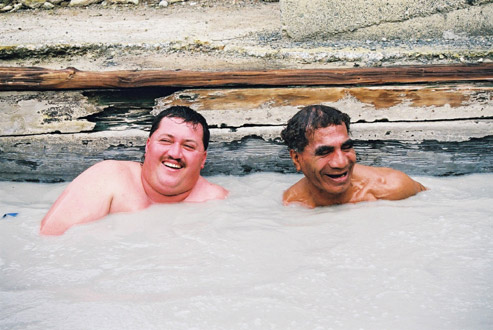
I don't recall any of us being involved in the car club so it isn't really a surprise to me that when Florian Habicht decided to make a documentary about their demolition derbies, I wouldn't recognise any of the people involved. Two of the central characters, John and Uncle Bimm, are pictured above enjoying the water. The rules of the demolition are very simple: everyone has a gallon of petrol, no ramming of the driver's door and last car still moving wins.

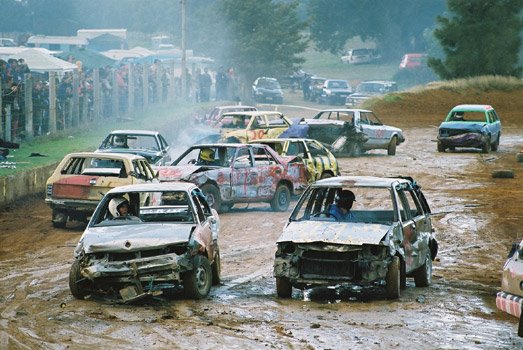
I don't think this car made it, somehow! About half of the hour long movie was footage of racing, if you can call it that - it was never quite clear which direction cars were supposed to be going on or indeed if there was a required direction. Instead, cars would be busily ramming each other, shooting around the track in reverse and generally going all over the place. That's when they were moving at all: apart from the contestants to contend with, the track was very muddy for several of the races. For the one summer race I saw, they got the old water tanker out to give it a good sprinkling. Just to show how democratic the sport of demolition derby racing is, a 15 year old girl won one competion. Behind the scenes footage revealed, however, that she might have had some assistance at one stage, and a little extra tender treatment. Still, cool that she won.
I even think it might be her car in the lead in this photo.

The rest of the movie was taken up with getting to know the guys - about how they got involved in the sport, their philosophies, about life in Kaikohe. Nothing too serious, just gently good humoured. Unusually, the special features of the DVD were as long as the main, if not longer - there were two full races, with "commentary" from John and Uncle Bimm largely consisting of jokes about making tea on all the busted radiators and advertising the various cars for sale, as they became immobilised. Good plain fun. Another special feature was the footage of the world premier in Auckland - most of the crew went down and made speeches:Uncle Bimm was threatening a sequel "Once Were Demolition Car Drivers". Half the audience (as well as the Ratana Brass Band), apparently, had made the trip down from Kaikohe - which must have made seeing it very special, as they recognised their town, friends or even themselves on screen. The bit that really touched me, however, had nothing to do with the racing. Florian was being interviewed on Bfm: instead of showing that, we saw a bunch of young kids, just skylarking, playing it up for the camera.

Labels:

Monday, September 18, 2006

The World of Henry Orient

I can't believe I had never heard of this film, as Ghost World borrows so heavily from it (and honours it by having Enid put a poster somewhat like this one on her bedroom wall) and it is a fantastic movie, so great that as soon as I had seen it, I bought the DVD. Thanks, Otago Film Society, for bringing it to my attention.

Of course, I went along simply because it was a Peter Sellers movie - there was some mention in the little blurb that he was some sort of pianist and had some kind of female problem with a woman. The reality is that he is a subsidiary character: the real stars are Val (Tippy Walker (who, apart from doing this movie at age 17 and then being in Peyton Place never really found a place in the movie business)) and Gil (Merrie Spaeth). They are two 14 year olds, who have just moved to New York. They bond over shared hatred of certain teachers and having teeth retainers.

So, the bulk of the movie is about their relationship: they spark off each other brilliantly, and arrive at great schemes, one of which involves Henry Orient. They first run into him as he pursues Stella Dunnworthy (Paula Prentiss): she is so worried about being found out that the only place they can get together is on a rock in Central Park. Unfortunately, it just happens to be the same rock Val and Gil are hiding behind in some game they're playing: they peer over the pair, popping their gum. Henry later describes this scene: "And then two small bladders came out of their mouths. And just when she was beginning to hum, too."

After that, quite inadvertantly, their paths cross. It is only when Gil and Val attend one of his performances (a very avant garde orchestral thing, where it probably would not have mattered that Henry had forgotten what key he was supposedly playing in) that Val decides she is in love with him. So their big scheme thereafter is to follow him: they enter a blood pact under which Gil is to do all she can to bring Val and Henry together. As guys go, Henry is of course complete crap but the movie never endangers the girls, rather has them engage in this harmless romantic pursuit. Along the way, Val and Gil continue to make up the most monstrous of stories: they really are a great pair of girls, and it is their joyous spirit which is what makes this movie. I've read accounts on IMDB of guys seeing this when it first came out and being completely smitten by Val in particular, and can fully see why. (In a very nice footnote to the movie, Tippy Walker herself has been contributing on the IMDB message board connected with it.)

But childhood and innocence unfortunately can't last forever, not even in the movies: reality in the form of parental control intervenes. Val's mum is a very stern Angela Lansbury (she reminded me quite a lot of Emily Gilmour, although I can't quite imagine Emily succumbing to the charms of someone like Henry Orient). Dad is Tom Bosley (of Happy Days fame): he has been your typical rich absentee dad, but really comes through at the end as someone rather cool.

Labels:

Sunday, September 17, 2006

Kenny

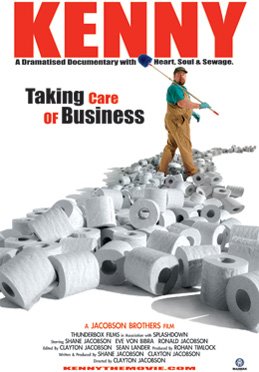
Would you watch a movie about a man who is some sort of a foreman in a gang which provides portable toilets at major public events? Not exactly the sort of film that jumps with appeal; some might be rather disdainful of it, given the topic. I rather suspect that is the point of this mockumentary about Kenny (Shane Jacobson), who works for a firm which obviously tries to deflect some of the snobbery by saying they deal in "corporate bathroom rentals". As Kenny himself puts it, I'd love to be able to say "I plumb toilets" and have someone say "Now that is something I've always wanted to do". But in his line of work, respect from the general public is quite lacking. So, respectable ladies think it is quite OK to give him a good telling off.

I know when the movie was starting and Kenny was starting to talk about w
hat his day would bring, I was wondering whether I should walk out. He's asking someone about the catering arrangements for their party, wondering if there will be any curries or other spicy foods. No? Well, no need for extra loos then. How on earth could they make anything interesting out of this? And yet, not only was it interesting, it was really funny, without (sorry) engaging in toilet humour. And, no, as far as I can recall, there are no shots of anything disgusting - we see a lot of portaloos, and we hear talk of the kind of work these guys might have to do to keep them functioning, but it isn't overloaded with such talk.


Instead, it is just a movie about this guy Kenny, who has quite a nice line in self-deprecating humour. His dad is really worried that he's not doing any better for himself, and he has the ex-wife from hell, but he's trying his hardest to keep his relationship going with his young son. And with his own father, despite him being one of the most ornery old codgers you could hope to meet, although I think we are supposed to extract the idea that behind all the criticism, he means well.
Then there is Kenny's brother, who is painted as a snob (but really, who would turn up to a posh restaurant as a guest in the uniform they wear when doing their corporate bathroom hire work?). All three of them end up on this excruciatingly cringe-worthy camping trip, meant somehow to show solidarity with dad. I did think it a little unfortunate that these two characters were drawn in such black and white terms

Kenny ultimately does good. He is sent to some huge bathroomware expo in Nashville, managing to make a friend with the Qantas hostess along the way. Once there, he is totally blown away by the technology on offer. I've read somewhere that he is a Crocvdile Dundee figure, but he reminded me more of the portrayal of Burt Munro in the World's Fastest Indian - ready to talk to anyone and innocent in the ways of the world. So, he gets talking to this delegation of Japanese businessmen, who are most impressed with his line of corporate
bathrooms. He's not there as a salesman, but that doesn't stop him.

One of the funniest things I have seen all year was in this movie. One of their jobs is the annual dragraces, where a group of locals routinely sets fire to the portaloos. Kenny is determined not to let it happen this year, and has a plan. Unofrtunately, it is not well executed, so we see him and his crew in their little truck still on the race track when the Monster Truck race starts.

So, despite the unlikely subject matter, this is a movie in which the central character grows on you, as a man with his own sort of dignity, to the point that you want things to work out for him and for people to stop being so horrible when they're really no better than he is. Admittedly, the movie does lay it on a bit thick in its closing scenes at the Melbourne Cup races, when some of the snobby people turn out to act more disgracefully than anything Kenny would do.

Labels: ,